Acupuncture for Shoulder Pain in Herndon & Reston, VA – Chronic & Acute Treatment
Shoulder pain has a way of making itself known in everything you do. Reaching for something on a high shelf. Rolling over in the middle of the night. Putting on a jacket. Driving. The shoulder is involved in almost every upper body movement – which means when it hurts, the disruption is constant.
Most people try to manage it. They rest it, ice it, take something for it, and hope it settles down on its own. Sometimes it does. But shoulder pain that keeps coming back – or that has been quietly getting worse over weeks and months – is telling you something that rest and ibuprofen are not equipped to address. At Calvert Rejuvenations in Herndon, VA, Dr. Calvert Thompson and Dr. Rubina Ogno treat shoulder pain by finding out what is actually driving it – and building a treatment plan around that, not around generic pain management. Book your appointment now or keep reading to understand what makes shoulder pain treatment at Calvert Rejuvenations different.
Why Shoulder Pain Is Notoriously Difficult to Resolve
The shoulder is the most mobile joint in the human body. That mobility comes at a cost – the joint depends on a complex arrangement of muscles, tendons, ligaments, and bursae to stay stable and functional. When any part of that arrangement is disrupted, the whole system compensates. And compensation, over time, creates new problems on top of the original one.
This is why shoulder pain that starts as a minor irritation so often becomes a chronic, recurring problem. The rotator cuff compensates for a stiff thoracic spine. The biceps tendon takes on load it was not designed to handle because the posterior capsule is tight. The upper trapezius and levator scapulae chronically overwork because the deep stabilizers have switched off following an old injury. By the time someone walks into a clinic describing shoulder pain, what they are describing is usually the accumulated result of several overlapping problems – not a single source that a single treatment will resolve.
Standard shoulder pain treatment rarely accounts for this. Physical therapy often addresses the site of pain without assessing what is driving it. Injections reduce inflammation temporarily without changing the mechanical or neurological patterns that keep re-creating it. Rest addresses the symptom without touching the cause.
Dr. Thompson and Dr. Ogno approach shoulder pain differently. Every assessment starts with the whole picture – movement patterns, compensation habits, nervous system state, injury history, and what the shoulder is actually being asked to do in your daily life.
Common Causes of Shoulder Pain Our Practitioners See
Understanding what is driving your shoulder pain is the first step toward resolving it. Common presentations at Calvert Rejuvenations include:
- Rotator cuff strain or partial tear – particularly the supraspinatus and infraspinatus tendons
- Subacromial impingement – where tendons are compressed during overhead movements
- Frozen shoulder (adhesive capsulitis) – progressive stiffening of the joint capsule that limits all movement
- Biceps tendinopathy – pain at the front of the shoulder with overhead or pulling movements
- Acromioclavicular (AC) joint dysfunction from falls, overuse, or repetitive strain
- Cervical referral – neck joint or nerve root irritation producing symptoms in the shoulder and arm
- Post-surgical stiffness and scar tissue restriction following shoulder repair
- Thoracic restriction that forces the shoulder to compensate for lost spinal mobility
- Myofascial trigger points in the rotator cuff, pectorals, or upper trapezius referring pain into the shoulder
Two patients presenting with identical shoulder pain descriptions can have completely different causes. That is why the assessment matters as much as the treatment itself.
Acupuncture for Shoulder Pain – What the Evidence Shows
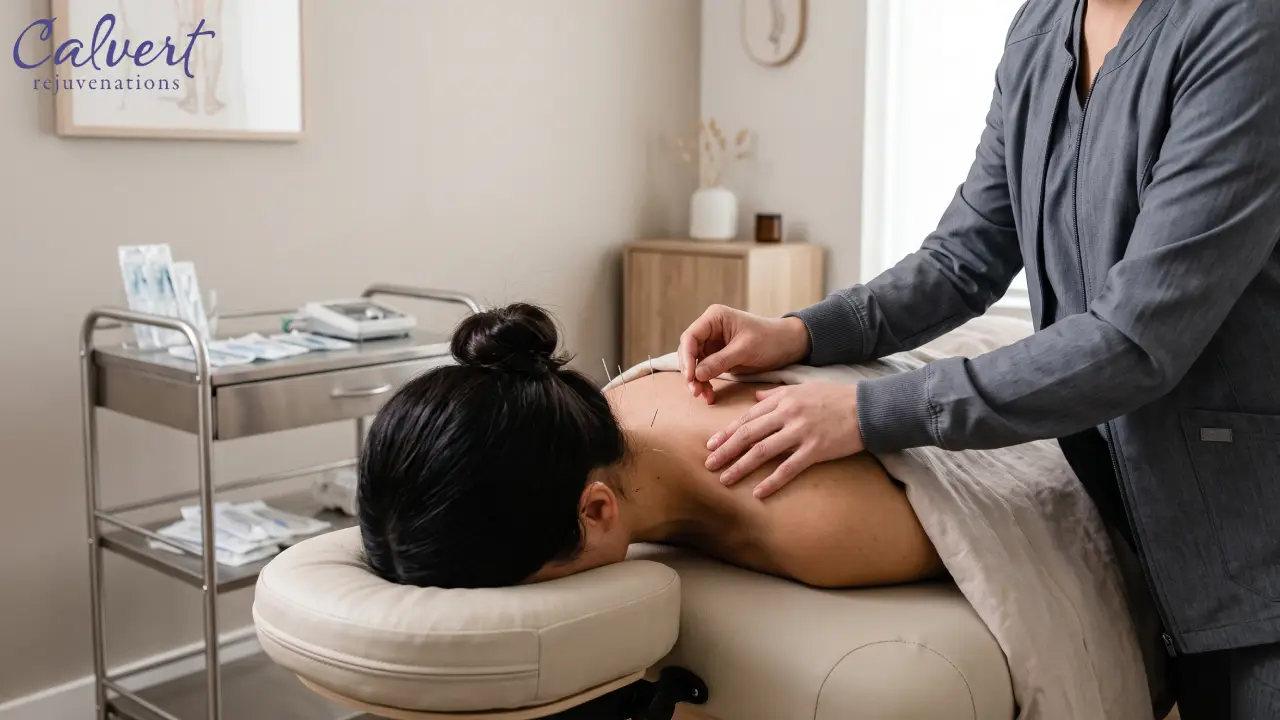
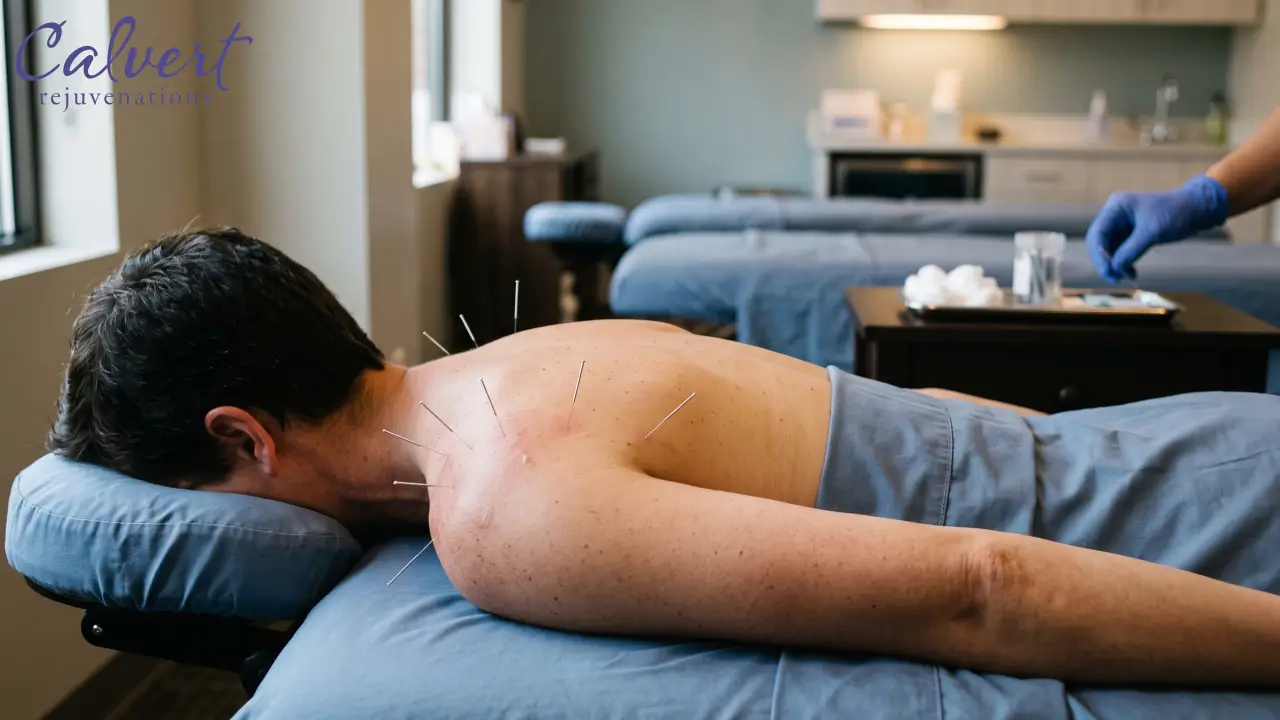
Acupuncture has a well-documented evidence base for shoulder pain. Research consistently shows measurable improvements in both pain intensity and range of motion in patients receiving acupuncture for shoulder conditions – including rotator cuff tendinopathy, impingement syndrome, and frozen shoulder.
A study examining acupuncture for shoulder pain found statistically significant reductions in pain scores and objectively measured improvements in shoulder range of motion compared to control groups. These were not just patient-reported changes – physical movement was measured before and after treatment and showed real functional improvement.
For frozen shoulder specifically – one of the most stubborn and distressing shoulder conditions – acupuncture has shown particularly strong results. Most patients with frozen shoulder respond best to twice-weekly treatment for several weeks. At Calvert Rejuvenations, this condition typically resolves in a couple of months with consistent acupuncture care. That is a significantly faster recovery than the year or two often required with conventional care alone. You can read more about how this works in our detailed guide to frozen shoulder and acupuncture in Herndon.
The mechanism behind acupuncture’s effectiveness for shoulder pain involves several pathways. It reduces local and systemic inflammation in the joint and surrounding soft tissue and releases myofascial trigger points that refer pain into the shoulder from adjacent structures. It improves circulation to tendons and bursae – tissue that heals poorly when blood supply is compromised. And it modulates the nervous system’s pain processing, which becomes sensitized in chronic shoulder conditions in a way that perpetuates pain even after the original tissue injury has settled.
Electroacupuncture – When Standard Needling Is Not Enough
For shoulder pain with a significant nerve component – cervical radiculopathy producing symptoms into the shoulder and arm, post-surgical nerve sensitivity, or chronic myofascial pain that has not responded to standard acupuncture – electroacupuncture adds a layer of neuromodulation that needle placement alone does not produce.
Gentle electrical stimulation through selected needles directly activates the nerve pathways involved in shoulder and arm pain. It disrupts the chronic tension-pain cycle that keeps muscles in a state of sustained contraction around a painful joint. It also significantly enhances local circulation to the rotator cuff tendons and surrounding soft tissue – improving the tissue environment that healing depends on.
Dr. Thompson holds advanced certification in ElectroAcupuncture Medicine. The decision to use electroacupuncture, and at which frequency and intensity, is made based on your specific pain pattern and how your body responds – not a standard protocol applied to every shoulder patient regardless of their presentation.
What Happens When the Problem Is Structural
Some shoulder pain has a structural component that acupuncture alone does not fully reach. Capsular adhesions in frozen shoulder. Post-surgical scar tissue that restricts movement. Fascial restrictions in the anterior chest and shoulder that pull the joint forward into a chronically impinged position. Thoracic stiffness that the shoulder is compensating for.
For these patients, integrative manual therapy provides a hands-on treatment layer that addresses the physical architecture of the problem. IMT uses precise, gentle techniques to release deep tissue restrictions – joint capsule adhesions, fascial layers, and myofascial holding patterns – that conventional massage does not reach and that acupuncture needles alone cannot physically mobilize.
The combination of acupuncture and IMT in the same treatment course is particularly effective for frozen shoulder and post-surgical shoulder recovery. Acupuncture addresses the inflammatory and neurological drivers. Manual therapy restores the physical mobility that adhesions have taken away. The shoulder starts moving the way it is supposed to – progressively, with each session building on the last.
The Muscular Layer – Deep Tissue Massage
Chronic shoulder pain builds layers of compensatory muscular tension that extend well beyond the joint itself. The upper trapezius. The pectorals. The levator scapulae. The posterior rotator cuff. The muscles of the upper arm. All of these adapt around a painful shoulder – some shortening, some switching off – creating a pattern of imbalance that perpetuates pain long after the original injury has healed.
Deep tissue massage addresses this muscular layer directly. Releasing the chronically shortened tissue around the shoulder – the anterior chest, the posterior capsule, the upper trapezius – reduces the compressive load on the joint and creates space for acupuncture and manual therapy to produce more lasting change. Patients who receive deep tissue massage alongside acupuncture consistently progress faster than those receiving either treatment in isolation.
Supporting Recovery From Within – Chinese Herbal Medicine
Shoulder conditions – particularly rotator cuff tendinopathy, frozen shoulder, and post-surgical recovery – have an internal healing dimension that external treatment alone does not fully address. Tendon tissue is avascular. It heals slowly because blood supply is limited. Systemic inflammation keeps the tissue environment reactive. Constitutional patterns in Traditional Chinese Medicine – blood stagnation, kidney deficiency, wind-cold invasion – create conditions where healing stalls.
Chinese herbal medicine addresses this internal dimension. Customized herbal formulas prescribed by Dr. Thompson or Dr. Ogno support circulation to the affected tissue, reduce systemic inflammation, and create a biological environment where the shoulder heals rather than cycling through flare-up and temporary relief. For patients with long-standing rotator cuff or frozen shoulder conditions, this internal layer is often what shifts treatment from managing the problem to actually resolving it.
Between Sessions – Infrared Sauna for Recovery Support
What happens between sessions matters as much as what happens during them. Chronic shoulder conditions – particularly those with an inflammatory component – respond well to consistent heat therapy between acupuncture appointments.
Our infrared sauna penetrates tissue at a deeper level than surface heat. It improves circulation to the shoulder joint and surrounding soft tissue. It reduces whole-body inflammation and promotes the nervous system downregulation that allows chronically guarded muscles to release. Patients with frozen shoulder and rotator cuff tendinopathy who incorporate regular sauna sessions between acupuncture appointments consistently report longer-lasting relief and faster overall progress.
Honest Expectations – What Treatment Produces and How Long It Takes
Acute shoulder pain from a specific injury or recent onset typically responds quickly. Meaningful improvement within 3 to 6 sessions is common. Full resolution within a short treatment course is realistic for many patients.
Chronic shoulder pain – frozen shoulder, long-standing rotator cuff tendinopathy, post-surgical stiffness – takes longer and requires more consistent treatment. The honest picture for frozen shoulder is two to three months of twice-weekly sessions. For chronic rotator cuff conditions, 8 to 12 sessions over a similar period produces meaningful cumulative improvement.
What distinguishes treatment at Calvert Rejuvenations from the usual cycle of temporary relief is the progressive nature of improvement. Each session builds on the last. The shoulder does not simply feel better temporarily – it gradually recovers function, range of motion, and stability. Patients regularly describe reaching a point where they have stopped thinking about their shoulder. That is the goal – not pain management, but resolution.
Who Should Consider Shoulder Pain Treatment at Calvert Rejuvenations
- Anyone with chronic shoulder pain that keeps returning despite standard treatment
- Patients with frozen shoulder at any stage of the condition
- Those recovering from rotator cuff surgery or other shoulder procedures
- Patients with rotator cuff tendinopathy or impingement that has not responded to physical therapy
- Those experiencing shoulder pain with associated neck symptoms or arm tingling
- Women in perimenopause or menopause experiencing shoulder stiffness and joint pain
- Anyone who wants to avoid cortisone injections or surgery and exhaust conservative options first
- Residents of Herndon, Reston, Sterling, Ashburn, Fairfax, and across Northern Virginia
To understand the full range of pain conditions Dr. Thompson and Dr. Ogno treat, explore our pain relief acupuncture services in Herndon and Reston.
Frequently Asked Questions
Q: Can acupuncture help a rotator cuff tear?
A: Yes – with an important distinction. Acupuncture does not repair structural tissue damage. But for partial tears and tendinopathy, it significantly reduces pain, improves circulation to the healing tissue, and restores the muscular balance around the shoulder that determines how much load the damaged tendon is carrying. Many patients with partial rotator cuff tears achieve excellent functional recovery without surgery through consistent acupuncture care. Full thickness tears typically require surgical repair, though acupuncture supports recovery both before and after the procedure.
Q: How is frozen shoulder treated at Calvert Rejuvenations?
A: Frozen shoulder responds best to twice-weekly acupuncture combined with integrative manual therapy to gradually restore capsular mobility. Treatment is structured in phases – first reducing pain and inflammation, then progressively restoring range of motion as the capsule releases. Most patients at Calvert Rejuvenations resolve frozen shoulder in two to three months rather than the year or more conventional care alone typically requires.
Q: My shoulder pain comes with tingling into my arm. Is that a shoulder problem or a neck problem?
A: Often both. Tingling into the arm from a shoulder presentation suggests nerve involvement – either cervical radiculopathy from the neck or thoracic outlet compression. Dr. Thompson and Dr. Ogno assess both regions at your initial consultation to identify the actual source. Treatment addresses whichever structures are contributing, not just the site of the reported pain.
Q: I had shoulder surgery six months ago and it still hurts. Can acupuncture help?
A: Yes. Post-surgical shoulder pain often persists because of scar tissue adhesion, nerve sensitivity from the surgical trauma, and the compensatory muscular patterns that developed around the joint before and after surgery. Acupuncture, integrative manual therapy, and deep tissue work address all three of these effectively. Many post-surgical patients at Calvert Rejuvenations progress significantly faster with integrative care than with rehabilitation alone.
Q: How do I know if my shoulder needs imaging before starting treatment?
A: Dr. Thompson and Dr. Ogno assess this at your initial consultation. Most shoulder pain does not require imaging before starting conservative treatment. If your presentation suggests something that warrants further investigation – significant trauma, progressive neurological symptoms, or findings on assessment that raise concern – they will tell you directly and refer appropriately.
Q: Where is Calvert Rejuvenations located?
A: We are located at 485 Carlisle Dr, Herndon, VA 20170 – serving patients from Reston, Herndon, Ashburn, Sterling, Fairfax, and across Northern Virginia.
Voted Best of Northern Virginia since 2009 and a Washingtonian Magazine Favorite Spa, Calvert Rejuvenations has served patients across Herndon and Reston since 2003.
Call: 571-323-1088 or book your appointment now and let Dr. Thompson and Dr. Ogno find out what is actually driving your shoulder pain.