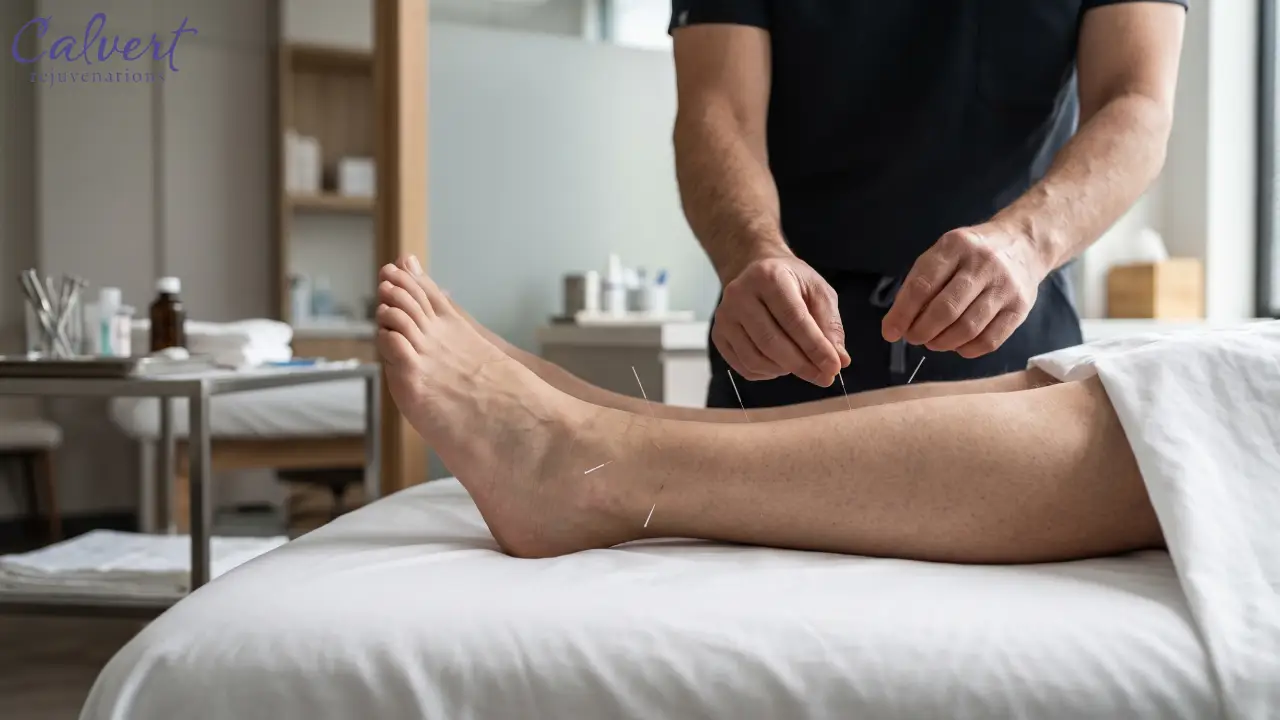
Acupuncture has a useful role in managing disrupted sleep, headaches, tension, and other concerns during perimenopause. Treatment starts with understanding what has changed for you and what you most want help with.
Perhaps your periods have become less predictable, you’re waking during the night, or you feel more on edge than usual. You may have several concerns that seem connected but don’t follow the same pattern every month. Those details help guide point selection and give us a clear starting place for tracking improvement.
At Calvert Rejuvenations, acupuncture in Herndon, VA for women’s health combines traditional Chinese medicine assessment with attention to your symptoms, medical history, and current treatment. You can receive acupuncture while continuing care with your gynecologist or other medical provider. Patients come to Calvert Rejuvenations in Herndon from Reston and nearby Northern Virginia communities.
Acupuncture for perimenopause symptoms: how we assess what has changed
Two patients can both have trouble sleeping and need different treatment plans. One may wake hot and restless. Another may feel cold, exhausted, and have heavier periods. When symptoms began, how they vary through your cycle, and what happens alongside them all help guide treatment.
An assessment covers bleeding, headaches, pain, mood, medications, and how your symptoms affect your day. A change in bleeding or symptoms that suggest another medical cause may also need evaluation. That is part of making a useful plan, rather than assuming every change is perimenopause. This assessment is part of our Fertility & Women’s Health acupuncture care.
Chinese medicine considers the relationship among these symptoms. Patterns described as Yin or Yang deficiency, Qi constraint, or overlapping presentations help guide point combinations and treatment methods. Tongue and wrist-pulse assessment can add to that picture.
Acupuncture stimulates sensory nerves and works with pathways involved in pain processing and autonomic responses. Chinese medicine describes aspects of treatment as supporting the free flow of Qi and Blood. Both perspectives inform care for tension, discomfort, and the broader pattern of how you’re feeling. [1]
The plan follows the assessment. Depending on your needs, we may focus on settling at night, reducing headache-related disruption, or easing muscle tension. We’ll agree on what meaningful improvement would look like for you and adjust treatment as we learn how you respond.
Acupuncture for perimenopause sleep problems and insomnia
There is encouraging evidence for electroacupuncture in perimenopausal insomnia. In a randomized trial of 84 women, electroacupuncture improved sleep quality compared with sham treatment over eight weeks. Activity monitors also recorded longer sleep time, better sleep efficiency, and fewer average awakenings. Because this was a small, single-site trial of electroacupuncture, the findings may not apply identically to every form of acupuncture. [2]
That is useful evidence when disrupted sleep is one of your main concerns. Your treatment still needs to fit your history and circumstances, including whether night sweats, pain, worry, or something else is interrupting rest.
Acupuncture for hot flashes and night sweats
For hot flashes and night sweats, studies have produced different results depending on the comparison used. In the Acupuncture in Menopause study, which included both perimenopausal and postmenopausal women, the acupuncture group had an average 36.7% reduction in hot-flash and night-sweat frequency at six months, compared with a 6% increase in the usual-care group. [3]
Benefits over sham treatment are less consistent. The Menopause Society’s 2023 guidance does not recommend acupuncture, including electroacupuncture, as an established treatment for hot flashes and night sweats. For appropriate candidates, hormone therapy is generally considered the most effective treatment for bothersome hot flashes and night sweats, and nonhormonal options are also available. [4]
How many acupuncture sessions for perimenopause?
An initial course may involve one or two visits a week for six to eight weeks, with a review around week four. This is an example of a starting plan, not the exact schedule used in every study. Frequency depends on your symptoms, how long they’ve been present, your response, and what is practical for you. For comparison, the electroacupuncture sleep study described above used 18 sessions over eight weeks: three visits weekly for four weeks, twice weekly for two weeks, then once weekly for two weeks. [2]
Some changes may show up early. More settled sleep, fewer headache days, or less tension between appointments can help us judge whether improvement is becoming consistent. We look at the changes together, including your own sense of how you feel and function.
As improvement holds, visits may be spaced farther apart. Some people benefit from occasional follow-up during more symptomatic stretches. If there is no meaningful change at a review, we reconsider the approach and whether another treatment or evaluation would be more useful. A course of care should have a clear purpose and regular opportunities to assess it.
Acupuncture, hormone therapy, and other perimenopause treatments
Different treatments have different timelines. Hormone therapy addresses changing hormone levels and can relieve several symptoms together. It can take up to three months to work fully, and finding the right preparation or dose may take adjustment. [5]
Gabapentin is a nonhormonal medicine prescribed off-label for hot flashes. A randomized trial found improvement by four weeks of regular use. That does not mean everyone waits four weeks to notice a change. Dizziness, unsteadiness, and drowsiness were more common early in treatment and eased over the following weeks in that trial. Your prescriber guides dosing and reviews benefit and side effects. [4], [6]
Sleep care also has several options. Some medicines can help promptly, while cognitive behavioral therapy for insomnia, or CBT-I, usually involves a six- to eight-week course and is commonly recommended first for chronic insomnia. Sleeping medication does not necessarily mean nightly treatment indefinitely. [7]
For acupuncture, regular appointments give us a way to follow changes over time and adjust treatment as the pattern shifts. You do not need to wait until every medication has been tried to explore it. The aim is a plan that helps you feel and function better, with enough consistency to assess progress and flexibility to change direction when needed.
What to expect at your first perimenopause acupuncture visit in Herndon
Bring your medication and supplement list, any relevant medical findings, and the questions you want answered. If you already track your cycles or symptoms, bring that too. A few dates in your phone can be enough to start.
Acupuncture uses very fine needles. You may feel a brief pinch, warmth, pressure, or an ache. Let us know what you’re noticing so treatment and positioning can be adjusted for your comfort. Please mention if you take blood thinners or have an implanted electronic device, especially when we’re considering electroacupuncture.
Please have new heavy bleeding, bleeding between periods, or any bleeding after menopause evaluated by your medical provider. Persistent anxiety, depression, or significant sleep difficulties also deserve appropriate assessment. Acupuncture can be part of a coordinated plan that addresses those needs.
FAQs
Q: How many acupuncture sessions will I need for perimenopause?
A: An initial course may involve one or two visits a week for six to eight weeks, with a review around week four. This is an example of a starting plan. Frequency depends on your symptoms, how long they’ve been present, your response, and what is practical for you. If there is no meaningful change at a review, we reconsider the approach and whether another treatment or evaluation would be more useful.
Q: Does acupuncture for perimenopause hurt?
A: Acupuncture uses very fine needles. You may feel a brief pinch, warmth, pressure, or an ache. Let us know what you’re noticing so treatment and positioning can be adjusted for your comfort.
Q: Can I have acupuncture alongside hormone therapy or other medical care?
A: Yes. You can receive acupuncture while continuing care with your gynecologist or other medical provider, and you do not need to wait until every medication has been tried to explore it. Bring your medication and supplement list to your first visit, and mention if you take blood thinners or have an implanted electronic device. New heavy bleeding, bleeding between periods, or any bleeding after menopause should be evaluated by your medical provider.
Q: Where can I find acupuncture for perimenopause In northern Virginia?
A: Calvert Rejuvenations is at 485 Carlisle Drive in Herndon, convenient to Reston and surrounding Northern Virginia communities, including Fairfax and Loudoun counties. To begin, book a women’s health acupuncture appointment or call 571-323-1088. We’ll start with your priorities and explain how treatment can fit.
Sources
- NCCIH. Acupuncture Effectiveness and Safety. https://www.nccih.nih.gov/health/acupuncture-effectiveness-and-safety
- Electroacupuncture versus Sham Acupuncture for Perimenopausal Insomnia. Nature and Science of Sleep, 2020. PubMed | Full text
- Avis et al. Acupuncture in Menopause (AIM) study. Menopause, 2016. https://pubmed.ncbi.nlm.nih.gov/27023860/
- The Menopause Society. The 2023 nonhormone therapy position statement. Menopause, 2023;30(6):573-590. PubMed | DOI
- NHS. Common questions about oestrogen tablets, patches, gel and spray. https://www.nhs.uk/medicines/hormone-replacement-therapy-hrt/oestrogen-tablets-patches-gel-and-spray/common-questions-about-oestrogen-tablets-patches-gel-and-spray/
- Butt et al. Gabapentin for the treatment of menopausal hot flashes. Menopause, 2008. https://pubmed.ncbi.nlm.nih.gov/17917611/
- NHLBI. Insomnia treatment. https://www.nhlbi.nih.gov/health/insomnia/treatment