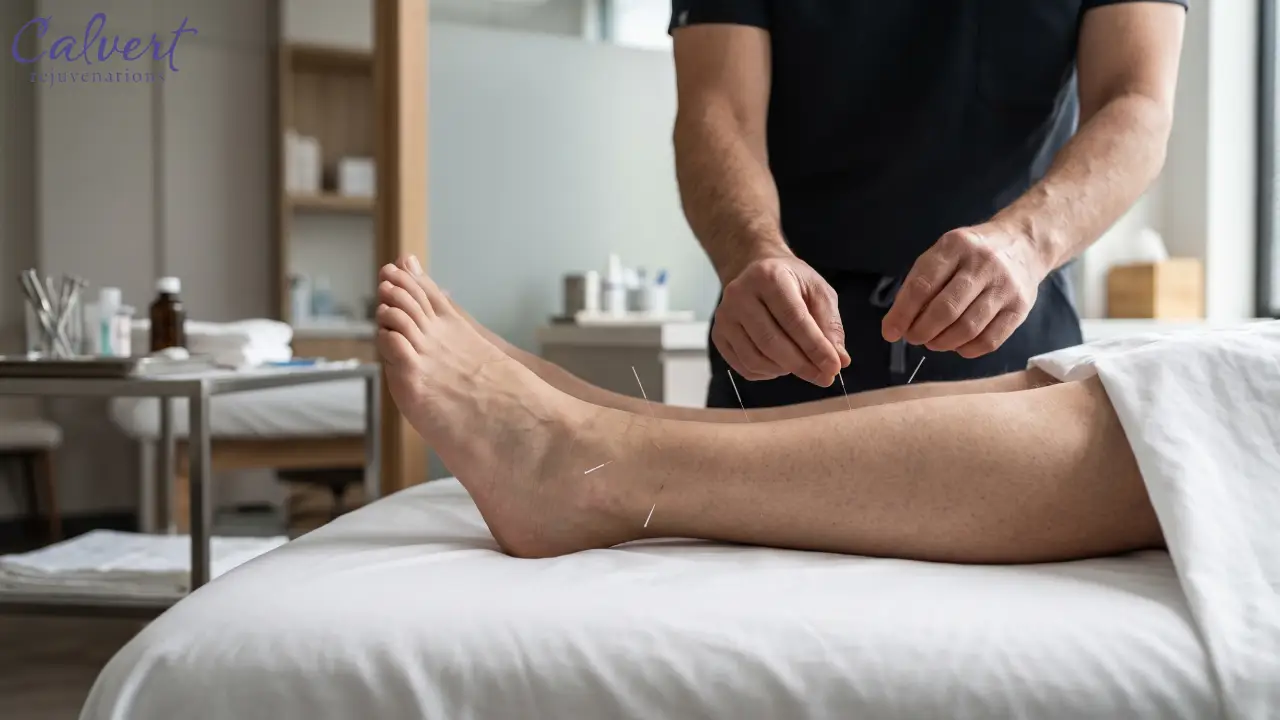
Postpartum Acupuncture in Herndon, VA: C-Section Recovery, Pain, and Breastfeeding Support
Feeding, carrying, interrupted sleep, and recovering from birth can put a lot of demands on your body at once. Acupuncture offers support for postpartum pain and tension, and has also been studied for low milk supply and breastfeeding discomfort. [1], [4], [7]
At Calvert Rejuvenations, acupuncture in Herndon, VA for postpartum care begins with how your delivery went, how you’re healing, and what you’d most like help with. The goal is to make daily activities more comfortable with a treatment plan that fits this stage of recovery. Patients come to Calvert Rejuvenations in Herndon from Reston and nearby Northern Virginia communities.
You may be dealing with neck pain during feeding, an aching back from carrying the baby, or discomfort that makes it difficult to settle when you finally have a chance to rest. Bring those details to the appointment. They help us focus treatment on what matters most to you.
Postpartum acupuncture in Herndon: how we assess your recovery
A postpartum assessment looks at both the discomfort and the circumstances around it. Where does it hurt? What brings it on? How does it affect feeding, lifting, walking, or sleeping? The assessment also covers bleeding, medications, feeding, emotional well-being, and any instructions from your obstetric team. Postpartum care sits within our women’s health and fertility acupuncture services.
For muscle and joint concerns, our pain relief acupuncture in Herndon approach follows an assessment of the areas involved and how they affect movement. Acupuncture stimulates sensory pathways involved in pain processing and other physiological responses. For you, the goal may be turning your head comfortably during a feed, lifting your baby with less back pain, or settling into a resting position without an aching shoulder. Those everyday changes help show whether treatment is working. [1]
Chinese medicine considers how symptoms fit together, including your energy, temperature, digestion, and ability to settle. Tongue and wrist-pulse assessment may also be part of the visit. These traditional patterns guide point selection and treatment methods. Chinese medicine approaches recovery as a process of restoring function and regulation. Depending on the assessment, treatment may emphasize replenishing what is depleted, easing constraint, or supporting the free flow of Qi and Blood. Fatigue after significant blood loss, for example, calls for a different approach from muscle tension with restlessness. Persistent fatigue or dizziness may also need medical evaluation for anemia, thyroid changes, or another cause.
Treatment is adjusted to your comfort, including positioning around a healing incision or tender breasts. We’ll discuss a starting schedule and review changes in pain, movement, and the activities that matter to you. A pain score can be helpful, and so can being able to feed or carry your baby more comfortably. Both belong in the conversation.
Postpartum acupuncture for C-section recovery and pain
Acupuncture has shown benefits for pain in the early recovery period after cesarean delivery. In a study involving 180 women having elective cesarean birth, acupuncture given before surgery reduced pain with movement and helped women get up and moving sooner. It was used alongside standard pain care. [2]
A 2025 review also found improvements in pain and bowel-function recovery after cesarean birth, although the studies varied considerably. These findings support a role in early postoperative care. They don’t tell us exactly how someone will respond several weeks later, so outpatient treatment follows your current assessment and response. [3]
For neck or back discomfort related to feeding and carrying, the broader evidence for acupuncture in pain care helps inform treatment alongside an assessment of the specific problem. New, persistent, or worsening pelvic or incision pain should also be reviewed by your medical team.
Postpartum acupuncture for sleep and energy
Sleep and energy are part of the assessment because they affect how you’re managing recovery. Waking to feed your baby is different from being unable to sleep when someone else has taken over. Let us know which is happening, along with any pain or tension that makes resting difficult. We can make those concerns part of the treatment plan and track what changes.
Acupuncture for low milk supply and breastfeeding support
Breastfeeding concerns deserve attention too, whether you’re worried about low supply, dealing with painful fullness, or producing more milk than your baby needs. Chinese medicine approaches lactation through regulation: supporting production when it is insufficient and addressing discomfort or stagnation when fullness and pain are the concern. Treatment is selected for that pattern, rather than automatically aiming for more milk.
Acupuncture has been shown to increase milk production in studies of women with low supply. A 2024 review of 19 trials reported positive results, although the certainty of the evidence was very low. In a separate trial, acupuncture alongside breastfeeding care reduced combined scores for breast redness, tension, and pain on days three and four. These findings give us a reason to include acupuncture when planning support for feeding difficulties. [4], [7]
There are specific points traditionally used for lactation, including SI1 at the little finger and CV17 at the center of the chest. Point combinations and techniques vary according to whether the aim is to tonify, meaning strengthen or replenish, or to ease stagnation and discomfort. This is part of Chinese medicine’s regulatory approach. [4], [8]
With oversupply, the aim is comfortable feeding and a supply that meets your baby’s needs. Acupuncture can be included for associated discomfort, while a lactation specialist guides supply management. Evidence for acupuncture directly reducing excess milk production is limited. Latch, milk transfer, and your baby’s weight gain also belong in the assessment. A hot, red, painful breast with fever or flu-like symptoms needs prompt medical assessment. [7], [9]
Postpartum emotional health, follow-up care, and warning signs
Your emotional recovery matters too. Acupuncture can be considered within a coordinated care plan, and persistent anxiety, low mood, or difficulty functioning should receive appropriate medical or mental-health assessment and treatment.
Keep your postpartum follow-up on the calendar. ACOG recommends contact with your obstetric provider within three weeks of birth and a comprehensive visit by twelve weeks, with earlier or additional care as needed. [5]
Seek immediate medical care for chest pain, trouble breathing, a severe or worsening headache, vision changes, fever, heavy bleeding, or painful one-sided swelling. Thoughts of harming yourself or your baby, confusion, or hallucinations also need urgent help. Call 911 for immediate danger. In the United States, call 988 or text 988 for crisis support. [6]
FAQs
Q: When can I start postpartum acupuncture after birth or a C-section?
Care begins with how your delivery went, how you’re healing, and any instructions from your obstetric team. Let us know when you gave birth and what you’d most like help with, and we’ll plan from there, including positioning around a healing incision or tender breasts. Keep your postpartum follow-up on the calendar too. ACOG recommends contact with your obstetric provider within three weeks of birth and a comprehensive visit by twelve weeks. [5]
Q: Is postpartum acupuncture safe while breastfeeding?
Treatment is adjusted to your comfort, including around tender breasts. Please tell us you’re breastfeeding, along with any breast pain, fullness, or concerns about supply, so we can include them in the plan. A hot, red, painful breast with fever or flu-like symptoms needs prompt medical assessment. [9]
Q: Can acupuncture help with low milk supply?
Acupuncture has been shown to increase milk production in studies of women with low supply. A 2024 review of 19 trials reported positive results, although the certainty of the evidence was very low. Chinese medicine approaches lactation through regulation, so treatment is selected for your pattern rather than automatically aiming for more milk. A lactation specialist can guide supply management, and latch, milk transfer, and your baby’s weight gain belong in the assessment too. [4]
Q: How many acupuncture sessions will I need after giving birth?
We’ll discuss a starting schedule and review changes in pain, movement, and the activities that matter to you. A pain score can be helpful, and so can being able to feed or carry your baby more comfortably. Both belong in the conversation.
Q: Where can I find postpartum acupuncture in Northern Virginia?
Calvert Rejuvenations is at 485 Carlisle Drive in Herndon. Patients come to us from Reston and nearby Northern Virginia communities, including Fairfax and Loudoun counties.
If you’d like help with postpartum pain, breastfeeding concerns, or other recovery needs, book a appointment for acupuncture at Calvert Rejuvenations or call 571-323-1088. Let us know when you gave birth and what you’d most like help with.
Sources
- NCCIH. Acupuncture: Effectiveness and Safety. https://www.nccih.nih.gov/health/acupuncture-effectiveness-and-safety
- Usichenko et al. Effectiveness of Acupuncture for Pain Control After Cesarean Delivery: A Randomized Clinical Trial. JAMA Network Open, 2022;5(2):e220517. https://doi.org/10.1001/jamanetworkopen.2022.0517
- Liu et al. Acupuncture for post-cesarean pain and gastrointestinal function recovery: a meta-analysis and systematic review. Frontiers in Medicine, 2025;12:1583898. https://doi.org/10.3389/fmed.2025.1583898
- Bao et al. Efficacy and safety of acupuncture for postpartum hypogalactia: a systematic review and meta-analysis of randomized controlled trials. PLOS ONE, 2024;19(6):e0303948. https://journals.plos.org/plosone/article?id=10.1371/journal.pone.0303948
- ACOG. Committee Opinion No. 736: Optimizing Postpartum Care. Obstetrics & Gynecology, 2018;131(5):e140-e150. https://www.acog.org/clinical/clinical-guidance/committee-opinion/articles/2018/05/optimizing-postpartum-care
- CDC. Urgent Maternal Warning Signs and Symptoms. https://www.cdc.gov/hearher/maternal-warning-signs/index.html
- Kvist et al. A randomised-controlled trial in Sweden of acupuncture and care interventions for the relief of inflammatory symptoms of the breast during lactation. Midwifery, 2007;23(2):184-195. https://www.lunduniversity.lu.se/lup/publication/a462065b-d4e5-4584-beec-2c1fc6eccecd
- Zhao and Guo. Acupuncture in 30 cases of postpartum hypogalactia. Journal of Traditional Chinese Medicine, 2006. Traditional point selection and techniques, not proof of efficacy. https://e-lactancia.org/media/papers/AcupunturaBF-2006.pdf
- Academy of Breastfeeding Medicine. Clinical Protocol #36: The Mastitis Spectrum, Revised 2022. Breastfeeding Medicine, 2022;17(5):360-376. https://www.bfmed.org/assets/ABM%20Protocol%20%2336.pdf